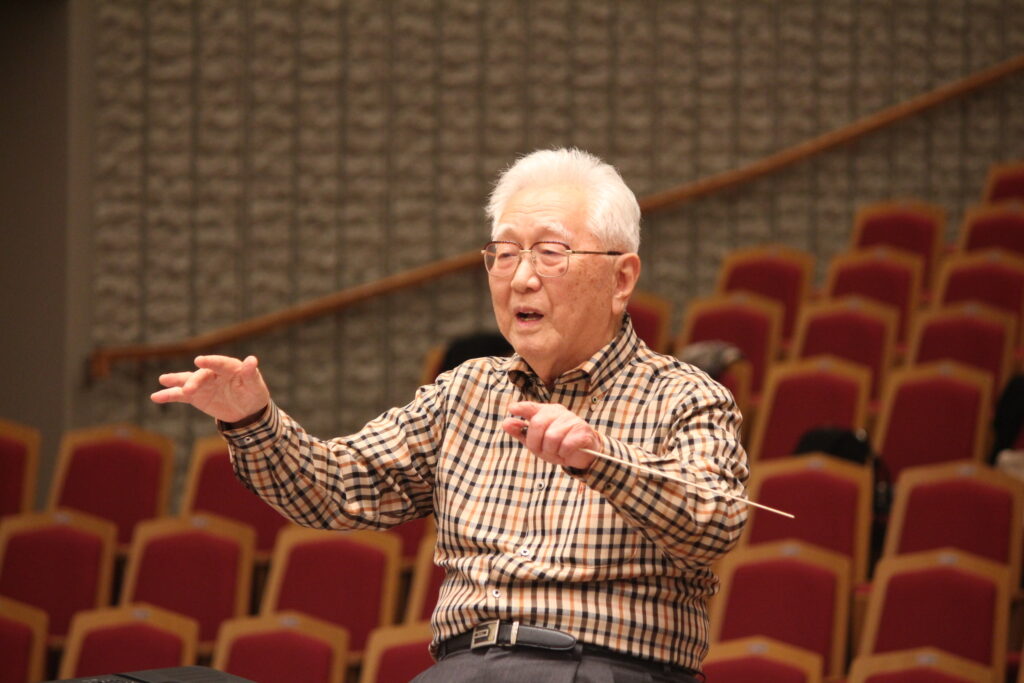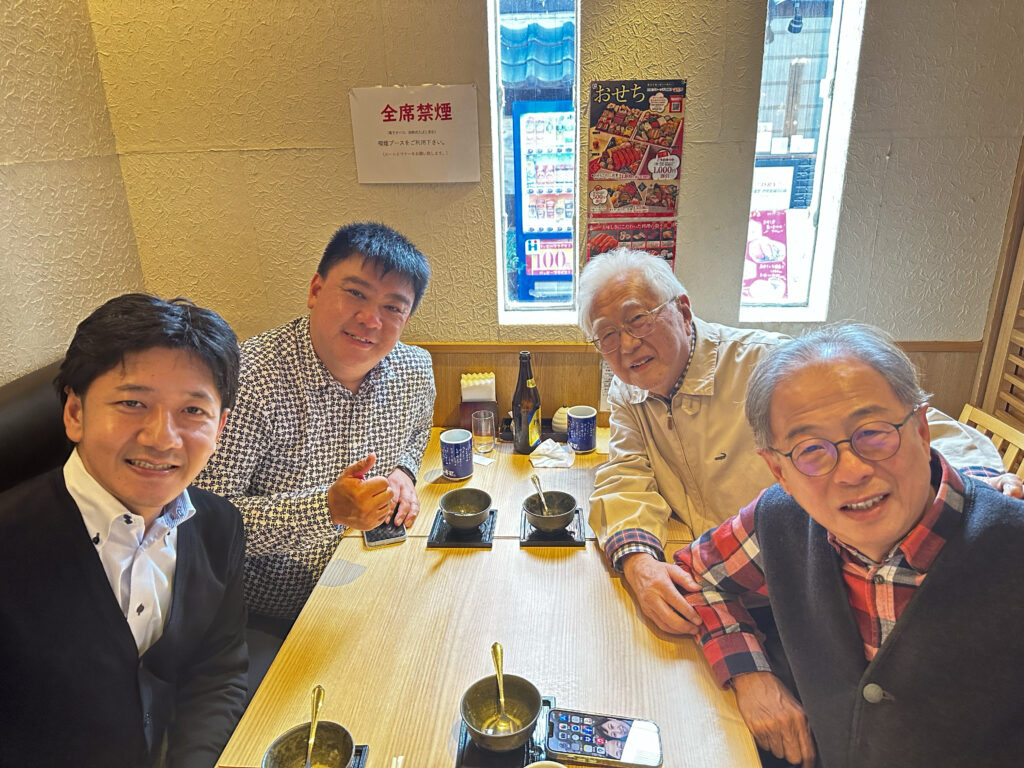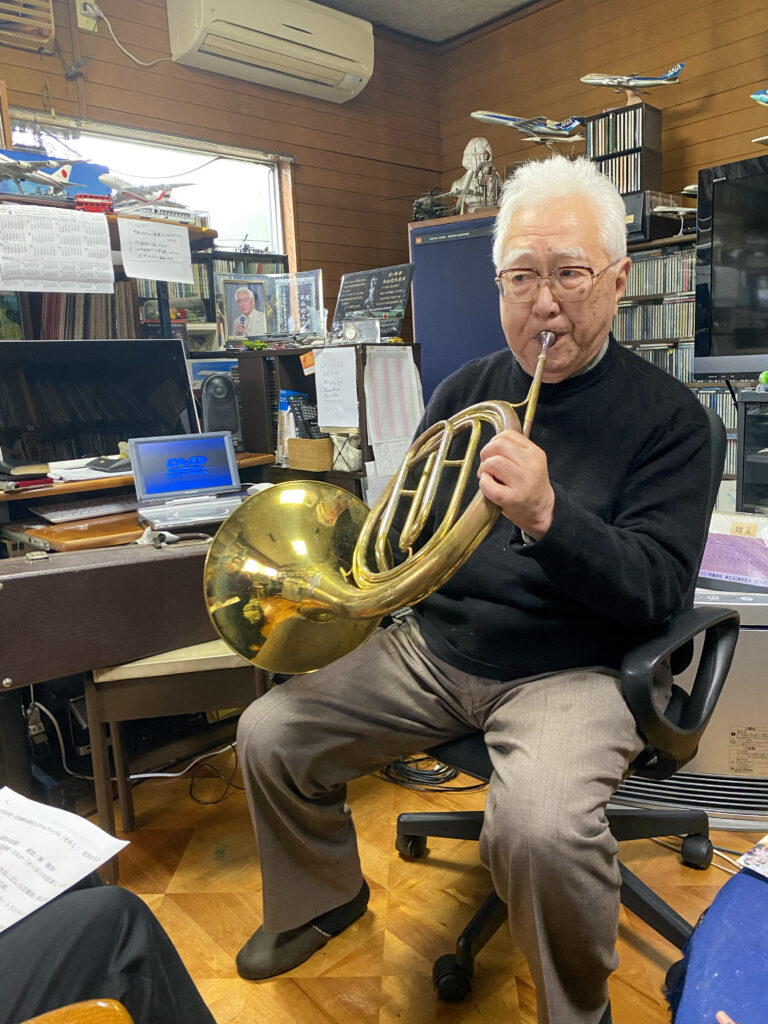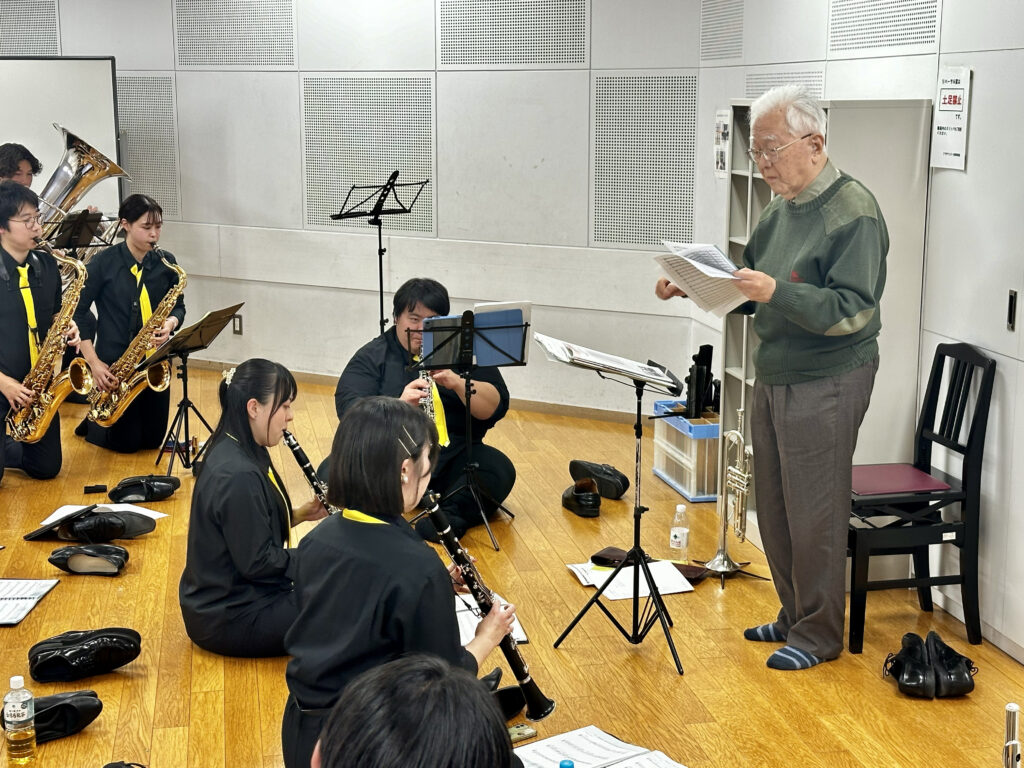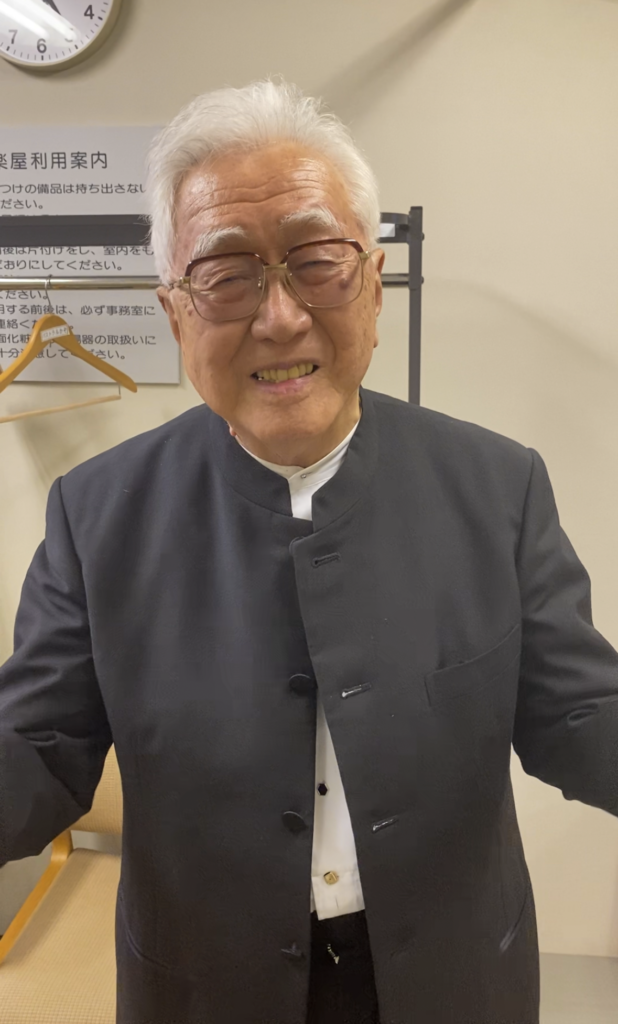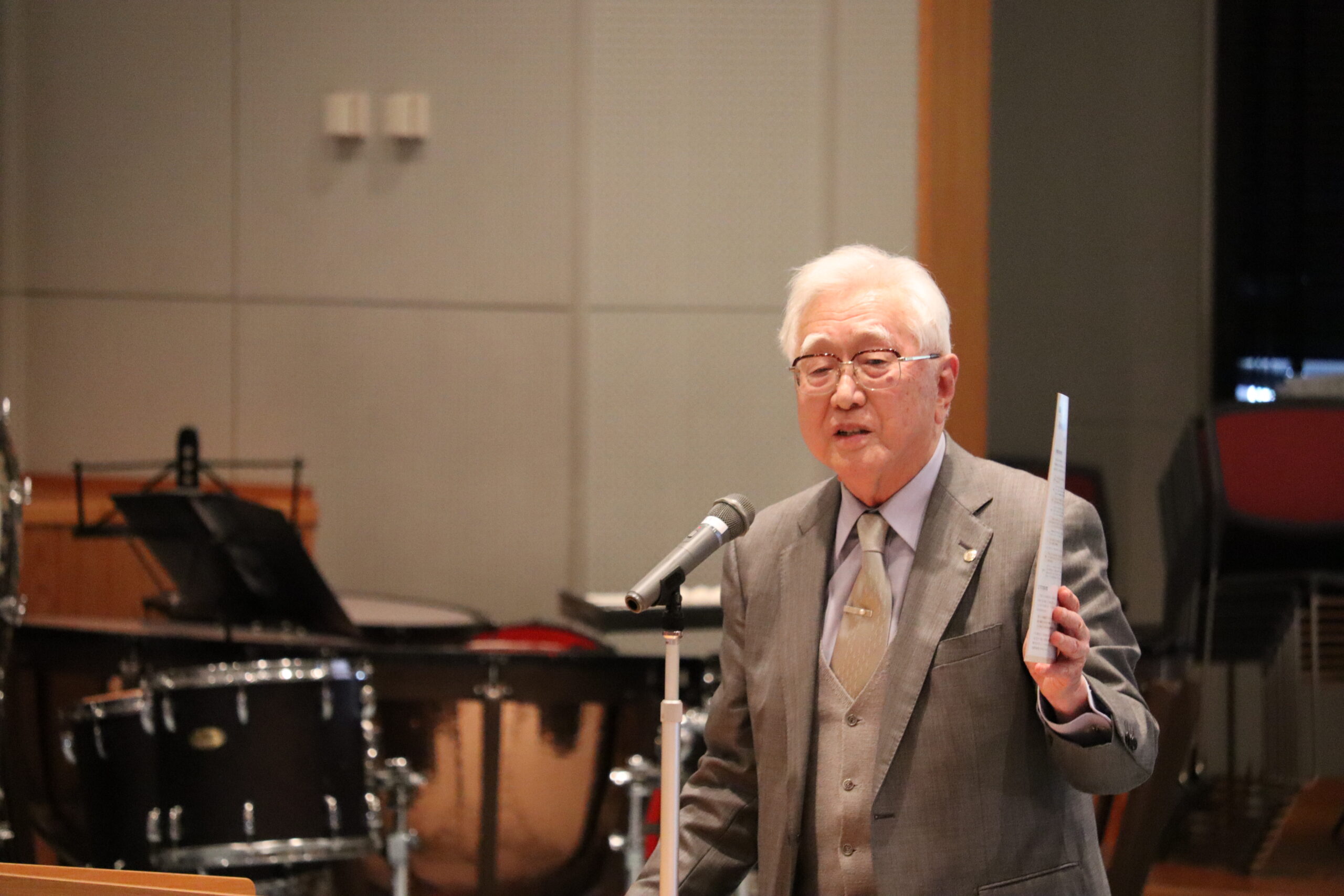
On 9th December, Mr. Toshio Akiyama passed away.
It goes without saying that his achievements were too monumental for me to recount fully here (and indeed, there are likely many aspects of his work that even I am unaware of). Therefore, I will limit myself to jotting down my personal memories of him.
I believe the first time I spoke to Mr. Akiyama directly was when I was 19 or 20 years old, at the Japan Band Clinic held at Nemu-no-Sato, Mie. Teachers from Taiwan were participating, and as I had just started learning Mandarin at university, I was fortunate enough to be introduced to Mr. Akiyama while conversing with the Taiwanese teachers.
Later, when I was in my third year of university, the wind band I belonged to needed to find a conductor. It was Mr. Akiyama who kindly agreed to serve as the guest conductor for that year’s annual concert. In addition to rehearsing our repertoire, he said, “Many students at Saitama University will likely become teachers in the future,” and proceeded to give a 90-minute lecture of “Wind Band Instruction 101”—the sort of content one would usually expect at a public extension course—right there in the practice room of our club hall. I still vividly remember him personally demonstrating on both the trumpet and the clarinet during that session. The concert he conducted was well received; the arranger of a piece that had only recently been published listened to our recording and praised it, saying it was “the best performance I have heard so far.”
As I approached my fourth year, belonging to the East Asian Culture course in the Faculty of Liberal Arts, I set the theme of my graduation thesis as “The Current Status and Challenges of Band Music in China.” There were naturally no academic precedents to rely on, so I was entirely dependent on fieldwork. It was Mr. Akiyama who provided immense assistance in this endeavour. When I mentioned that I intended to go on a field survey during the summer holidays, he immediately sent faxes to several teachers in China to arrange meetings for me (this was at a time when internet connections were still scarce in China). Although Mr. Akiyama could not speak Chinese, I was astounded to see him communicating effectively using a mix of his pre-war knowledge of Classical Chinese and mimicked modern Chinese! When I successfully completed my thesis and showed it to him, he said, “This is excellent content. You should join the JBA (Japanese Band Directors Association), publish this in the bulletin, and present your research at the general meeting.” He immediately handed me a membership application form with his own name already written in the recommender section.
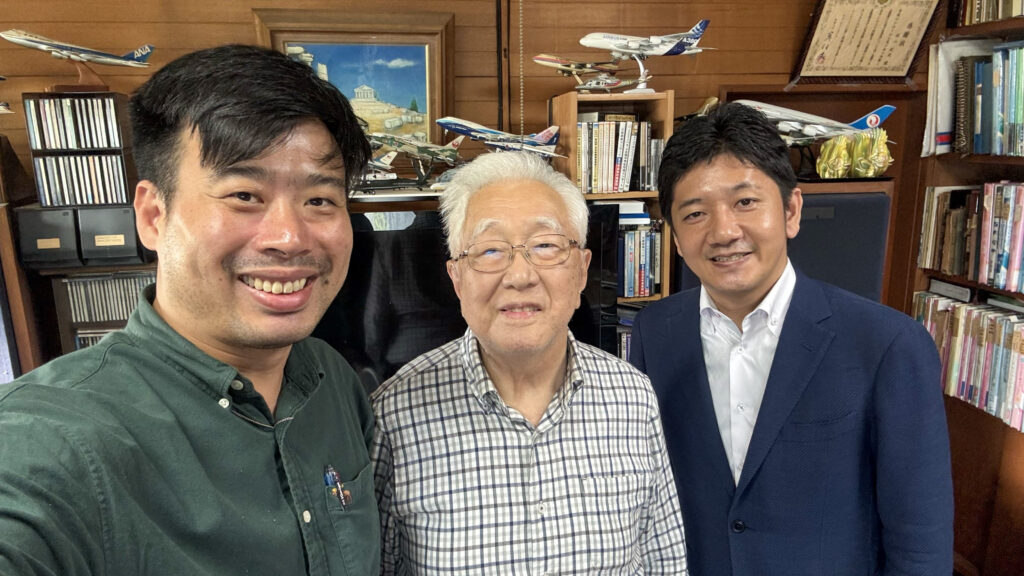
Since then, although I occasionally translated teaching materials into Chinese for him or was surprised to discover that the school song of the public school in Saitama where I taught was composed by Toshio Akiyama, it was not until the 2010s that I began to work directly with him again more frequently. As I started to collaborate with wind band colleagues across various Asian countries, I would visit his home several times a year to consult with him or report on my activities. Every time I visited, copies of materials relevant to the topics I had mentioned in advance were already prepared and waiting on the table (and if I was with a foreign guest, the materials were, of course, in English). Furthermore, whenever we spoke, I was constantly amazed by his fluid memory—recalling exactly what happened in which year without hesitation—as well as the breadth of his network and the speed of his responses.
In recent years, it was a great joy for me to work with him on both local and international fronts: preparing slides and handouts for his lecture at the JBA Saitama Branch’s “Band Day in Saitama,” having the band I conduct serve as a demonstration band for his sessions, seeing him attend the JBA Saitama Solo Contest for a whole day as an audience member, and collaborating on the post-COVID resumption of APBDA (Asia and Pacific Band Directors’ Association) activities.
I regard myself on being a “generalist” type of wind band professional, but looking back now, Mr. Akiyama—who was active in an extremely wide range of fields including conducting, teaching, writing, association management, international exchange, radio presenting, composition, and arrangement—was truly a “Titan among Generalists.” Of course, it is presumptuous to even compare myself to such a unique and great figure, and I am well aware that many others had deeper and closer relationships with him. Nevertheless, from my personal perspective, there is no doubt that the influence I received from Mr. Akiyama occupies a massive part of my life.
It is no exaggeration to say that the foundation of modern wind band music in Asia rests almost entirely on the soil that Mr. Akiyama cultivated. And among those who visited him regularly, I suspect I am one of the youngest-generation members. It is precisely the role assigned to our generation to develop the world of band music in a better direction. Particularly as someone who received his guidance and mentorship directly, I intend to do my utmost in the future to repay that debt of gratitude.
Thank you so much, Akiyama sensei. May you rest in peace.